

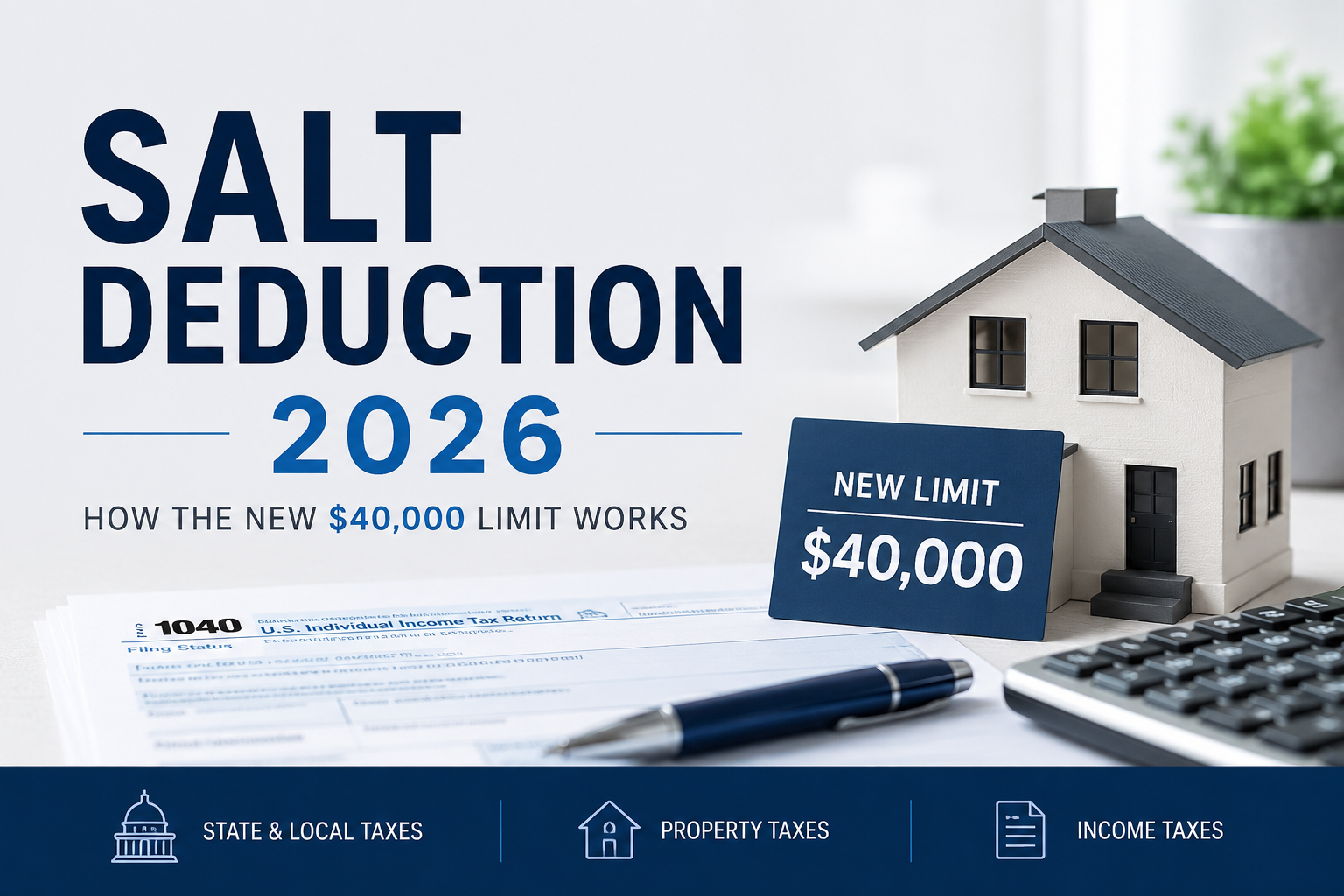
For years, homeowners in high-tax states like New York faced a frustrating federal tax limitation: even if they paid tens of thousands of dollars in property and state income taxes, their federal state and local tax deduction was generally capped at just $10,000.
That has changed.
Under the new federal tax law, the SALT deduction limit increased to $40,000 for 2025, with inflation adjustments scheduled thereafter. The higher limit creates a potentially significant tax-planning opportunity for homeowners and other taxpayers who itemize deductions. The benefit is particularly relevant in areas such as Larchmont, NY and Westchester County, where property taxes alone can easily exceed the old $10,000 cap.
However, the new SALT rules aren’t as simple as automatically deducting $40,000. Income limitations, filing status and itemization all matter.
Here’s what taxpayers should know.
What Is the SALT Deduction?
SALT stands for state and local taxes.
Taxpayers who itemize deductions on Schedule A of their federal income tax return may generally deduct certain state and local taxes they paid during the year, subject to the applicable SALT limitation.
Common deductible taxes include:
- State and local income taxes
- State and local real estate taxes
- Certain personal property taxes
Taxpayers generally choose between deducting state and local income taxes or state and local sales taxes. They cannot deduct both.
For New York residents, state income taxes and property taxes are usually the major components of the deduction.
Simple Example
Assume a married couple in Westchester County pays:
- $22,000 in property taxes
- $18,000 in New York State income taxes
Their total potentially deductible SALT expenses would be:
$22,000 + $18,000 = $40,000
Under the old $10,000 limitation, as much as $30,000 of those taxes could have provided no additional federal itemized deduction.
The higher SALT cap can substantially change that calculation.
What Is the SALT Deduction Limit for 2026?
The major change began with tax year 2025.
The federal SALT deduction limit increased from $10,000 to $40,000 for most filers for 2025, subject to an income-based limitation. The limit is $20,000 for married taxpayers filing separately.
The law provides for the $40,000 amount to increase by 1% annually through 2029 before reverting to $10,000 in 2030 unless Congress changes the law again.
That means taxpayers doing 2026 tax planning should no longer automatically assume their federal deduction for state and local taxes stops at $10,000.
This is particularly important when estimating whether itemizing deductions will now produce a better result than taking the standard deduction.
Why the $40,000 SALT Deduction Matters in New York
The change can be especially valuable for taxpayers living in high-tax states.
Consider a homeowner in Larchmont, NY.
Between Westchester County property taxes and New York State income taxes, a household can easily have SALT expenses well above $10,000.
Under the previous cap, much of that spending produced no incremental federal deduction.
With the higher limit, more of those taxes may now be deductible.
For example, suppose a married couple has:
- $25,000 of property taxes
- $15,000 of New York State income taxes
- $12,000 of mortgage interest
- $5,000 of qualifying charitable contributions
Their potential itemized deductions before considering other limitations could reach:
SALT: $40,000
Mortgage interest: $12,000
Charitable contributions: $5,000
Total: $57,000
That is a very different tax picture than when the SALT component was capped at $10,000.
There Is an Income Limit on the Higher SALT Deduction
One of the most important details is that the expanded deduction isn’t unlimited for higher-income households.
For 2025, the $40,000 SALT cap begins to phase down once modified adjusted gross income exceeds $500,000.
The reduction is generally 30% of the amount by which MAGI exceeds the threshold.
However, the deduction does not immediately disappear.
The SALT cap cannot be reduced below $10,000 under the phaseout.
Example of the SALT Phaseout
Suppose a married couple has:
- $600,000 of MAGI
- $45,000 of otherwise deductible state and local taxes
Their income exceeds the $500,000 threshold by:
$600,000 − $500,000 = $100,000
A 30% reduction would equal:
$100,000 × 30% = $30,000
The $40,000 cap would therefore be reduced by $30,000, leaving a $10,000 SALT deduction limit.
This phaseout makes proactive tax planning particularly important for households with income near or above the threshold.
Do You Have to Itemize to Claim the SALT Deduction?
Yes.
The SALT deduction is an itemized deduction reported on Schedule A of Form 1040.
That means taxpayers generally benefit only if their total itemized deductions exceed their standard deduction.
For 2026, the standard deduction is:
- $16,100 for single filers
- $32,200 for married couples filing jointly
- $24,150 for heads of household
As a result, the higher SALT cap may cause some taxpayers who previously took the standard deduction to reconsider itemizing.
For homeowners in Westchester County with substantial property taxes, mortgage interest and charitable contributions, running both calculations is especially important.
What Taxes Count Toward the SALT Deduction?
Understanding what qualifies is critical.
State and Local Income Taxes
New York State income taxes paid during the year generally count toward the SALT deduction.
This may include taxes paid through:
- W-2 withholding
- Estimated tax payments
- Certain prior-year state tax payments made during the current year
Real Estate Property Taxes
State and local real estate taxes can generally qualify when they are imposed on real property and assessed uniformly for public purposes.
For homeowners in Larchmont and throughout Westchester County, property taxes can represent a substantial portion of the SALT deduction.
Personal Property Taxes
Certain personal property taxes can qualify if they are imposed annually and based on the property’s value.
What Doesn’t Count?
Not every payment made to a state or municipality is deductible.
Items that generally don’t qualify include:
- Federal income taxes
- Social Security taxes
- HOA fees
- Water and sewer service charges
- Transfer and stamp taxes
- Assessments for certain local improvements
Taxpayers should therefore avoid assuming that every payment appearing on a property-related bill qualifies as a federal deduction.
SALT Deduction Strategies for High-Income Earners
The increased SALT cap creates planning opportunities, but taxpayers should avoid making transactions solely to generate deductions.
Instead, consider the overall tax picture.
1. Monitor Your MAGI
The income-based phaseout makes modified adjusted gross income increasingly important.
Taxpayers approaching the phaseout threshold should model the impact of additional income such as:
- Bonuses
- Capital gains
- Business income
- Roth conversions
- Investment income
Recognizing a large gain, for example, could affect more than just the tax on the gain itself. It could also reduce the amount of SALT deduction available.
2. Review Itemizing Versus the Standard Deduction
Don’t assume that because you historically took the standard deduction, you should continue doing so.
The expanded SALT limit may materially change the calculation.
3. Coordinate Charitable Giving
Taxpayers who are close to the itemization threshold may benefit from coordinating charitable contributions with other deductible expenses.
One strategy is sometimes called “bunching,” where multiple years of planned charitable contributions are made in one tax year to increase itemized deductions.
The appropriate strategy depends on the taxpayer’s circumstances.
4. Review Estimated State Tax Payments
Taxpayers making New York estimated tax payments should consider the timing of payments as part of year-end planning.
However, simply prepaying taxes doesn’t guarantee a deduction. Federal tax rules governing timing and deductibility still apply.
A Westchester County SALT Deduction Example
Consider a married couple living in Westchester County earning $300,000 annually.
Suppose they pay:
- $24,000 in property taxes
- $20,000 in New York State income taxes
- $15,000 in deductible mortgage interest
- $6,000 in charitable contributions
Their SALT payments total $44,000.
Assuming the applicable SALT cap is approximately $40,000 and they aren’t affected by the income phaseout, roughly $40,000 could potentially count toward their itemized deductions.
Adding the other deductions produces:
SALT deduction: $40,000
Mortgage interest: $15,000
Charitable contributions: $6,000
Potential itemized deductions: $61,000
This is why the SALT change can be particularly meaningful for Westchester homeowners.
A household that previously received little incremental benefit from property taxes above the $10,000 cap could now potentially receive a much larger federal deduction.
Does the SALT Deduction Reduce Your Taxes Dollar for Dollar?
No.
A tax deduction isn’t the same thing as a tax credit.
A tax credit generally reduces your tax liability dollar for dollar.
A tax deduction reduces taxable income.
For example, an additional $20,000 deduction doesn’t necessarily save $20,000 in federal taxes.
If that deduction effectively reduces income taxed at a 24% marginal rate, the simplified federal tax benefit could be approximately:
$20,000 × 24% = $4,800
Actual savings depend on your complete tax situation, including your taxable income, filing status, other deductions and applicable limitations.
Should New York Taxpayers Change Their Tax Strategy?
For many taxpayers, the answer may be yes.
The higher SALT deduction makes it worthwhile to revisit assumptions that may have been correct under the previous $10,000 cap.
In particular, New York taxpayers should review:
- Whether they should itemize
- Total property and state income taxes
- Expected 2026 income
- Capital gains
- Charitable contributions
- Mortgage interest
- Estimated tax payments
- The potential SALT income phaseout
Tax planning is most effective before December 31, when taxpayers still have time to make certain decisions.
Frequently Asked Questions About the SALT Deduction
What is the SALT deduction limit?
The SALT deduction limit increased to $40,000 for 2025 for most taxpayers, subject to an income-based limitation. The amount is scheduled to increase modestly in subsequent years through 2029.
Can I deduct all of my Westchester County property taxes?
Property taxes generally qualify as state and local real estate taxes if they meet federal requirements. However, your total deduction remains subject to the applicable SALT cap and other tax rules.
Does the SALT deduction apply if I take the standard deduction?
No. SALT is an itemized deduction. You generally must itemize deductions on Schedule A to receive a federal tax benefit from it.
Is the $40,000 SALT deduction permanent?
No. Under current law, the expanded limitation is temporary. The higher cap applies through 2029 and is scheduled to return to $10,000 in 2030 unless Congress changes the law.
Does the SALT cap apply to high-income taxpayers?
Yes. The expanded deduction is subject to an income-based phaseout. High-income taxpayers should calculate the limitation rather than automatically assuming they qualify for the full cap.
Conclusion: Plan Around the SALT Deduction in 2026
The expanded SALT deduction represents one of the most significant recent federal tax changes for homeowners and taxpayers in high-tax states like New York.
For taxpayers in Larchmont, NY and Westchester County, the difference can be particularly meaningful. Property taxes plus New York State income taxes can easily exceed the old $10,000 limit, potentially making itemizing far more valuable than it was in previous years.
But the higher deduction isn’t automatic. Income phaseouts, filing status, the standard deduction and other itemized deductions all affect the final benefit.
Super Value Accounting helps individuals, families, real estate investors and business owners understand how changes in federal and New York tax law affect their specific situation.
If you want to determine how much of your state and local taxes you can deduct—or identify additional tax-planning opportunities before year-end—contact Super Value Accounting to schedule a tax planning consultation.
This article is for general informational purposes and should not be considered individualized tax advice. Tax laws and IRS guidance can change, and the appropriate treatment depends on your specific circumstances.
References:


